
A Crow Is Never Just Black
- Dec 22, 2025
- 2 min read
What Crows Really See When They Look at Each Other
To human eyes, crows appear simple in colour—sleek, glossy, and black from head to toe. But this familiar view hides a remarkable truth. To other crows, a crow is not black at all. Instead, it is likely a rich tapestry of colours, patterns, and signals that humans are simply unable to see.
This difference comes down to how crows perceive the world—and how their vision far surpasses our own.
Humans vs Crows: Two Very Different Ways of Seeing
Humans are trichromatic, meaning we see colour using three types of cone cells in our eyes: red, green, and blue. Crows, like most birds, are tetrachromatic.
This means crows have a fourth type of colour receptor, allowing them to see wavelengths of light that are completely invisible to us—most notably ultraviolet (UV) light.
Where we see “black,” a crow sees detail.
A Crow Is Never Just Black: The Hidden Colours in Crow Feathers
Crow feathers are never just black. Under sunlight, they already show hints of blue, purple, and green iridescence to human eyes. But to a crow, this effect is dramatically amplified.
Their feathers reflect ultraviolet light in complex ways, creating:
Subtle colour gradients
Shimmering patterns
High-contrast edges
Individual “signatures” unique to each bird
What appears to us as uniform darkness may look to a crow like a living mosaic of colour and sheen.
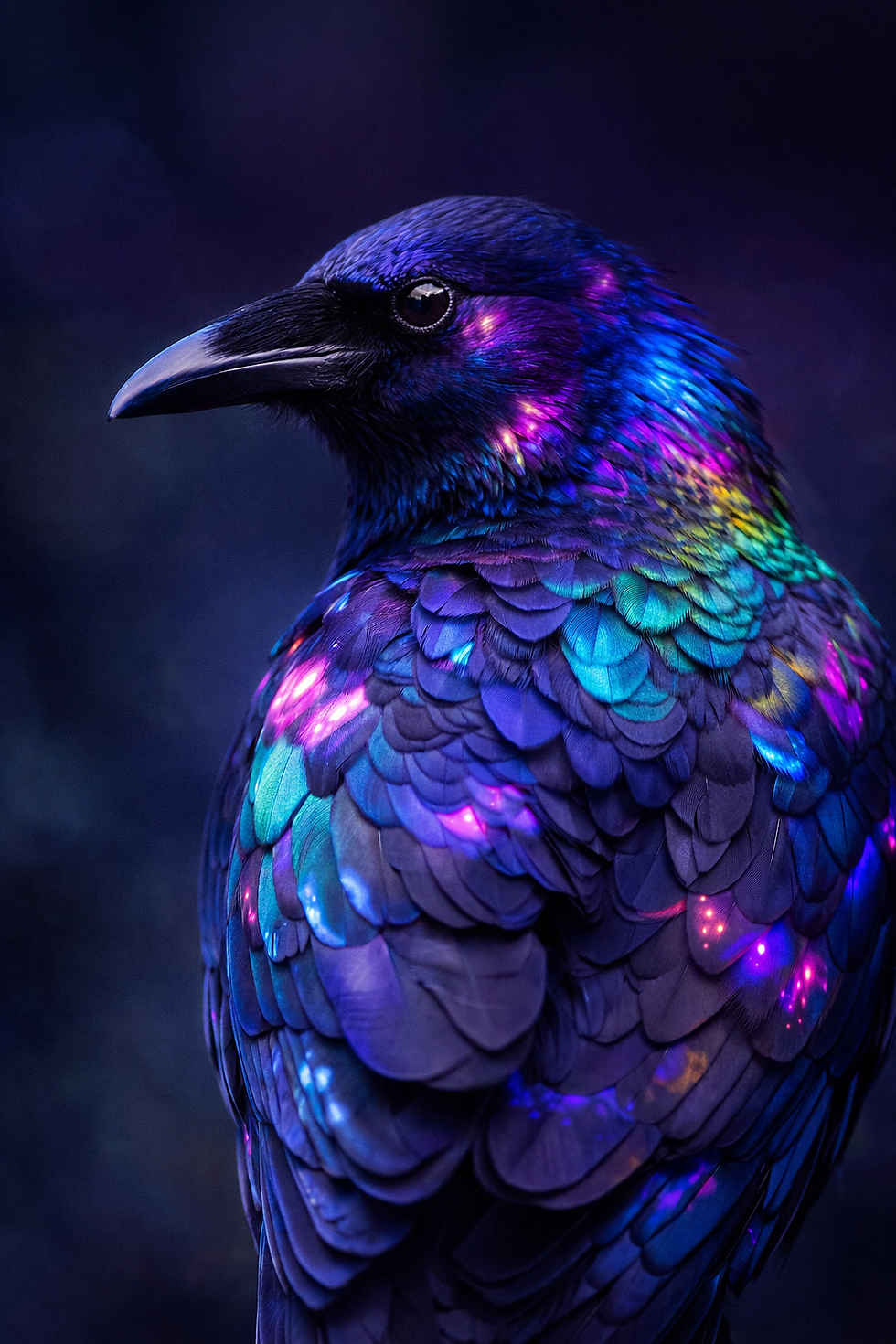
Structural Colour: Why Feathers Change with Light
Much of what a crow sees comes from structural colour, not pigment.
Crow feathers are built from microscopic layers that bend and scatter light. Depending on the angle of the sun and the viewer, different wavelengths—especially UV—are reflected back.
To another crow, this means:
A moving bird changes colour as it moves
Feathers signal health, age, and condition
Certain areas (wings, neck, head) stand out vividly
In social species like crows, these visual cues are incredibly important.
What a Crow Sees When It Looks at Another Crow
When a crow looks at another crow, it may see:
Ultraviolet highlights along wings and shoulders
Colour shifts in feathers indicating movement or posture
Distinct visual markers identifying individuals
Health indicators, such as feather quality and symmetry
This enhanced vision helps crows:
Recognise family members and rivals
Assess potential mates
Read social signals during group interactions
Coordinate behaviour within flocks
In other words, crow society is visually rich—just not to us.
Why This Matters: Intelligence Meets Perception
Crows are already known for their intelligence, memory, and problem-solving abilities. When combined with advanced colour perception, their world becomes even more complex.
They are not just clever animals navigating a grey landscape. They are highly visual beings living in a world layered with signals, contrasts, and colours we can never fully experience.
A World Hidden in Plain Sight
The idea that crows see each other as multicoloured challenges our assumptions—not just about birds, but about perception itself.
What we dismiss as “plain” or “simple” may, in another species’ eyes, be rich with meaning. Every time you see a crow perched against the sky, remember:you are only seeing a fraction of the story.
To another crow, that black silhouette may be alive with colour.


Comments